
Incident Response and Organizational Health
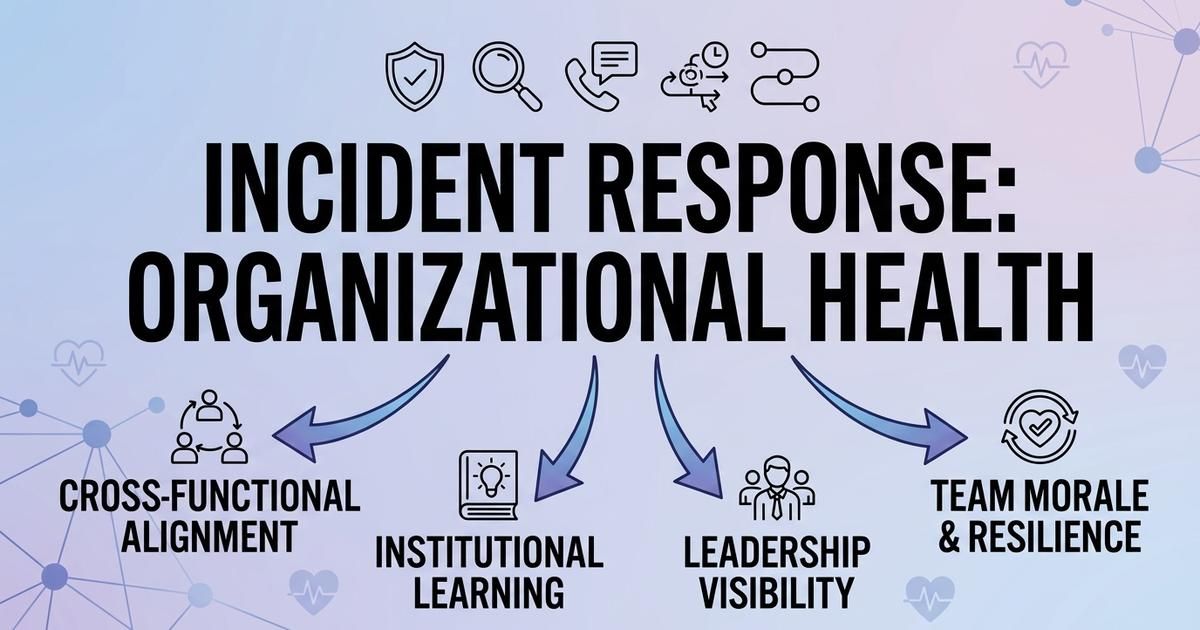

Incident Response: What a Bad Outage Reveals About Your Organization
Nearly half of all outages are discovered because a customer complained first — not because internal monitoring caught it. That single statistic tells leadership more about organizational readiness than any post-incident report ever will.
Want to know how your organization would really handle a major outage?
Every organization will eventually have a bad outage. That part is close to inevitable — even the best-resourced technology companies in the world have experienced multi-hour outages affecting hundreds of millions of users. What separates resilient organizations from fragile ones isn't whether an outage happens. It's what the response reveals about how the organization actually operates under pressure — and increasingly, that response has become a board-level financial concern rather than a purely technical one.
Stats That Matter
- The average cost of downtime now ranges from $14,000 per minute for midsize businesses to $23,750 per minute for large enterprises.
- The average Global 2000 company loses roughly $300 million a year to unplanned outages and service degradation — a figure that has grown 50% in just two years.
- 47% of outages are first discovered when a customer complains, not through internal monitoring — a direct signal of detection capability, or the lack of it.
Why the Real Cost Extends Well Beyond the Outage Window
Leadership often mentally prices an outage by multiplying downtime minutes by revenue-per-minute, which understates the actual cost significantly. A single major incident triggers a measurable stock price impact for public companies, and brand health measurably takes roughly two months to recover after a major incident is remediated — meaning the damage window is far longer than the technical outage itself.
Customer trust erosion compounds this further. A meaningful share of customers report they would stop trusting a company after experiencing a significant service disruption, and a large share say they'll switch providers after even one or two bad experiences. For any organization competing on customer relationships rather than pure commodity pricing, this reputational cost frequently exceeds the direct revenue loss from the outage itself.
What an Outage Actually Reveals
The specific way an organization handles an incident is diagnostic. It surfaces exactly the kind of organizational health issues that don't show up anywhere else, because most days, nothing forces them into view.
Detection capability. If an outage is discovered by a customer complaint rather than internal monitoring, that reveals a gap in observability that exists on every ordinary day too — it's just invisible until something breaks badly enough for a customer to notice first.
Decision-making clarity under pressure. Incidents move fast, and organizations without clear authority for who can make which call during an incident lose critical time to unnecessary escalation, exactly when speed matters most. This is often the same decision-making ambiguity discussed elsewhere in this series as a drag on ordinary engineering velocity — it just becomes visible and costly during a crisis instead of quietly slowing down every normal release.
Cross-team communication. A large and growing share of outages now originate from third-party services — SaaS platforms, APIs, cloud providers — rather than internal systems, which means effective incident response increasingly requires coordination across vendor relationships and internal teams simultaneously, not just within a single engineering team.
Whether the organization learns or just recovers. Some organizations restore service and move on. Others use every incident to systematically reduce the likelihood and impact of the next one. Over time, this is the single biggest predictor of whether an organization's downtime trend improves or stays flat year after year.
The Recovery Speed Gap Is Wide — And It's a Choice
Recovery time varies enormously between organizations experiencing structurally similar incidents, and the gap is rarely about the underlying technology — it's about preparation. Incidents triggered by human error, for instance, can stretch recovery time into multiple days when an organization lacks clear runbooks, while well-prepared teams running the same category of incident recover in a fraction of that time because the response is rehearsed rather than improvised.
This points to a concrete, low-cost intervention many organizations skip: building incident response runbooks for the most likely failure scenarios and running tabletop exercises regularly, so the team's first real experience with a category of failure isn't during an actual crisis with customers watching.
Why the Postmortem Matters More Than the Fix
It's tempting to treat an incident as resolved once service is restored. This misses where the actual long-term value lives. A structured postmortem — conducted promptly, focused on root cause and response timeline rather than blame, and shared with leadership — is what converts a single expensive incident into an organizational asset that reduces the likelihood and cost of the next one.
Organizations that skip this step, or treat it as a purely technical debrief that never reaches leadership, tend to see the same categories of incidents recur, because the underlying conditions that caused them were never actually addressed — only the immediate symptom was.
What Leadership Should Ask For
Detection metrics, not just uptime metrics. How many incidents were caught internally versus reported by customers first? This single ratio reveals more about monitoring maturity than an uptime percentage ever will.
A clear, pre-agreed incident command structure. Who has authority to make which decisions during an incident, and is that documented and rehearsed, or does it get figured out live during the next crisis?
A postmortem process that reaches leadership, not just engineering. Root causes that trace back to organizational decisions — under-resourcing, unclear ownership, deferred technical debt — need to be visible above the engineering team for the underlying pattern to actually change.
Key Takeaways
- Downtime now costs large enterprises up to $23,750 per minute, and the average Global 2000 company loses roughly $300 million a year to unplanned outages.
- The true cost of an outage extends well beyond the downtime window — into stock price, brand recovery time, and customer trust erosion that can outlast the technical fix by months.
- How an organization handles an incident reveals detection capability, decision-making clarity, and cross-team coordination that are otherwise invisible on a normal day.
- Recovery speed is largely a function of preparation, not luck — rehearsed runbooks and tabletop exercises measurably reduce recovery time.
- A postmortem that reaches leadership, not just engineering, is what prevents the same category of incident from recurring.
What to Do Next
If your organization doesn't have rehearsed incident response runbooks, or your postmortems never make it above the engineering team, that gap will get discovered during your next real incident — at the worst possible time to discover it.
I work with a trainer who specializes in exactly this: helping leadership and technical teams build the incident response discipline that turns inevitable failures into organizational learning rather than repeated damage. If this is on your radar for the next quarter, call or contact me and I'll help you get started.